How to Choose the Right Induction Motor for Your Needs?
Induction motors are critical in various industrial applications. They account for nearly 60% of the electric motors used globally, according to the International Electrotechnical Commission. Selecting the right induction motor can significantly impact efficiency and operational costs. That’s why understanding your specific needs is essential.
Expert Mike Johnson, a renowned authority in motor technology, states, "Choosing an induction motor involves more than just horsepower ratings." His insight emphasizes the importance of matching the motor’s specifications to the application. Factors like load characteristics, efficiency ratings, and starting requirements can influence performance.
Despite the availability of various induction motors, mistakes in selection are common. Many overlook the importance of operating conditions. Inadequate consideration of environmental factors can lead to unsatisfactory motor performance. Investing time in the selection process can yield significant long-term benefits.

Understanding the Basics of Induction Motors
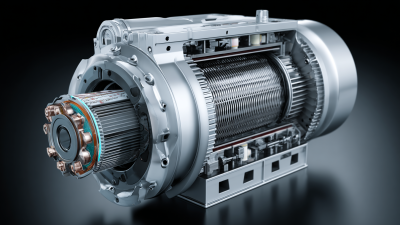
Induction motors are essential in diverse applications. They are reliable and efficient. Understanding their basics is key when choosing the right one. An induction motor operates by converting electrical energy into mechanical energy. It mainly consists of a rotor and a stator. The stator generates a magnetic field, which induces current in the rotor. This interaction creates rotational motion.
When selecting an induction motor, consider power requirements and voltage. Determine the precise horsepower needed for your application. The voltage must match your power supply to avoid operational issues. Also, examine the motor's efficiency rating. Higher efficiency often leads to long-term savings.
Tips: Always assess the environment where the motor will operate. Factors like temperature and humidity can affect performance. Additionally, consider the type of load the motor will handle. Start-up torque requirements differ based on the application. Understanding these aspects can improve motor performance significantly.
Another essential detail is the motor's frame size. Ensure it fits within your space limitations. You may reflect on how different frame sizes affect installation costs. Getting it right the first time can save you from costly modifications.
Identifying Your Power and Torque Requirements
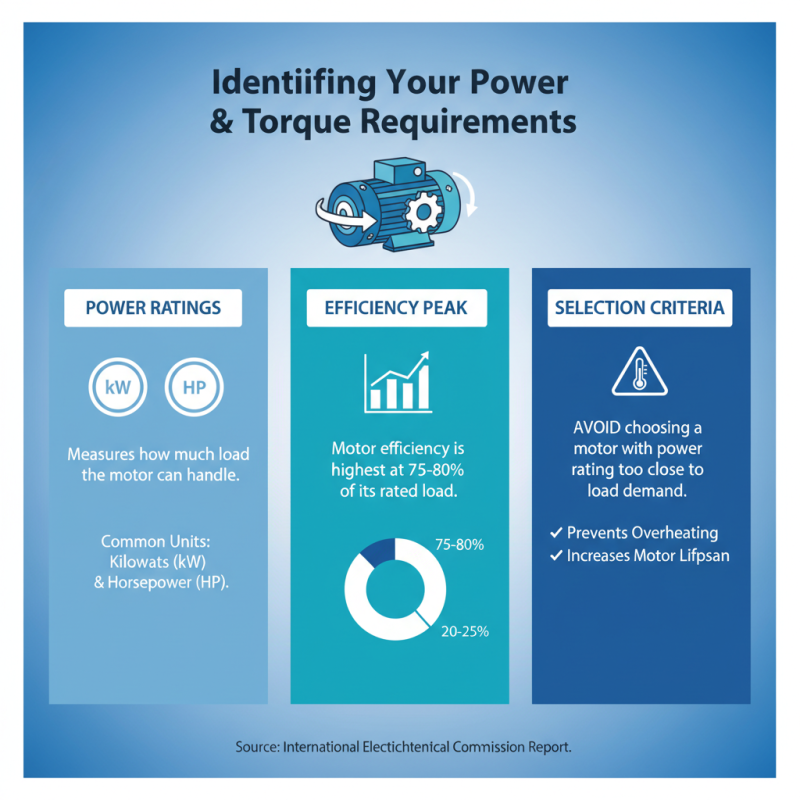
When selecting the right induction motor, understanding power and torque requirements is crucial. Power ratings, usually measured in kilowatts (kW) or horsepower (HP), dictate how much load the motor can handle. According to a report from the International Electrotechnical Commission, a motor's efficiency typically peaks at 75-80% of its rated load. Choosing a motor with a power rating too close to a load's demand can lead to overheating and reduced lifespan.
Torque is another essential factor. It determines how much rotational force the motor produces. For instance, in industrial applications, a torque requirement below 1 Nm is typically suitable for small motors. Moreover, as torque increases, the motor size often needs to scale as well. A 2018 study by the National Electrical Manufacturers Association indicated that improper torque selection could reduce operational efficiency by up to 20%. Balancing these factors involves understanding specific application needs and potential future demands.
Contemplating power and torque should not be simplistic. The ideal motor might perform inadequately if the load changes or if it operates beyond optimal conditions. Regular performance audits can help identify inefficiencies. By considering various operational scenarios, users can make informed choices about their induction motors.
Evaluating Operating Conditions and Duty Cycles
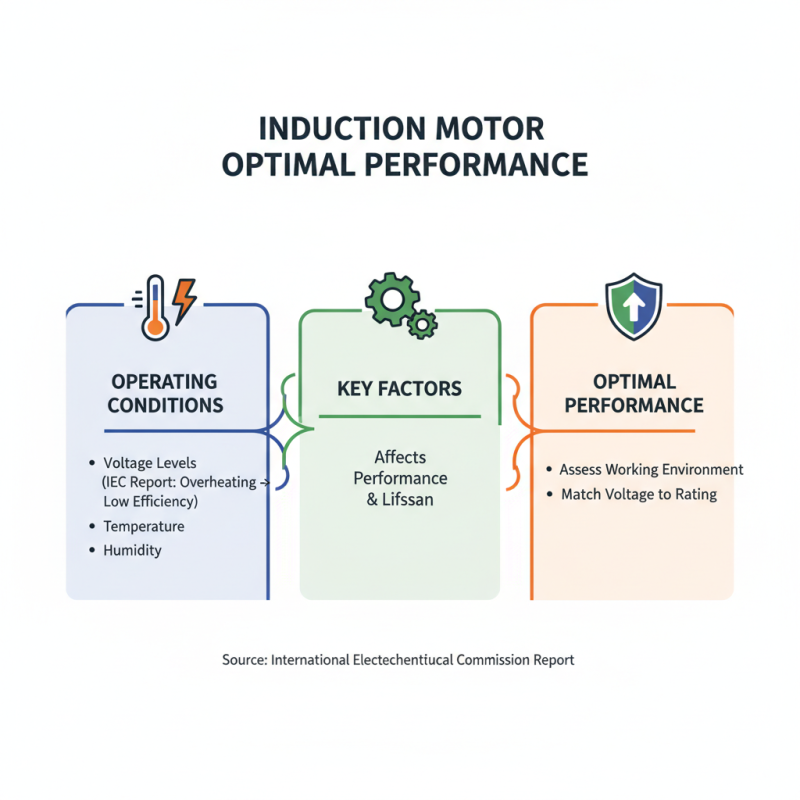
When selecting an induction motor, understanding its operating conditions is crucial. Factors like voltage levels, temperature, and humidity can significantly affect performance and lifespan. According to a report by the International Electrotechnical Commission, voltages outside the motor’s rating can lead to overheating, resulting in decreased efficiency. For optimal performance, you must assess the working environment closely.
Duty cycles also play a significant role in motor selection. Motors operate under various cycle categories: continuous, intermittent, or variable. The American National Standards Institute states that a motor working at a continuous duty cycle requires robust insulation to handle prolonged use. If the motor operates intermittently, its thermal management needs are different. Insufficient knowledge of these cycles can lead to failures or increased repair costs over time.
Careful evaluation of these elements can prevent operational issues. Ignoring specific conditions like start-stop cycles can result in lower efficiency. A flawed understanding of duty cycles may lead to selecting an incorrect motor size. This misstep could cause early burnout or inefficient power usage. Emphasizing operational specifics is vital for matching the motor to its application accurately.
Exploring Efficiency Ratings and Standards
When selecting an induction motor, efficiency ratings play a crucial role. The National Electrical Manufacturers Association (NEMA) has set standards that categorize motors based on their efficiency. For instance, NEMA Premium motors boast an efficiency of 90% or higher. This means they convert more electrical energy into mechanical energy, reducing operating costs.
Different applications require varying levels of efficiency. An industrial facility may see significant savings with high-efficiency motors, potentially saving up to 30% on energy costs. However, not all applications benefit from these high ratings. A lower efficiency motor may be more cost-effective for certain short-term tasks. It's essential to evaluate the specific needs of the application to avoid excess expenses.
Understanding the operating environment is also key. Conditions like temperature and humidity can affect efficiency. For instance, a motor operating in a hot, humid environment may not perform as efficiently as one in a controlled setting. This raises questions about the practicality of selecting a motor purely based on its efficiency rating. Thus, it's important to strike a balance between efficiency and application compatibility.
Selecting Additional Features and Controls for Your Motor
When selecting an induction motor, additional features and controls are crucial for optimizing performance. Features like variable frequency drives (VFDs) allow for precise speed control. According to the International Energy Agency, using VFDs can improve energy efficiency by up to 30%. This capability is particularly beneficial in applications requiring variable speeds and load adjustments.
Consider integrating thermal protection systems as well. These systems prevent overheating and extend motor life. Reports from the Electric Power Research Institute indicate that overheating is a major cause of motor failure, accounting for 60% of maintenance issues. Simple solutions like thermal sensors can help identify and mitigate risks effectively.
It’s also essential to choose the right control systems. Advanced controls offer data analytics and monitoring, leading to informed decision-making. Industry studies have shown that predictive maintenance can reduce downtime by 25%. However, implementing sophisticated controls may require careful assessment of your operation's specific needs and capabilities. Balancing complexity and usability is vital for optimal motor performance.
How to Choose the Right Induction Motor for Your Needs? - Selecting Additional Features and Controls for Your Motor
| Parameter |
Description |
Examples |
| Power Rating |
The power output of the motor, typically measured in kilowatts (kW) or horsepower (HP). |
1 HP, 5 HP, 10 kW |
| Voltage |
The electrical voltage required to operate the motor. |
208V, 480V, 600V |
| Phase |
The number of phases in the power supply; common options are single-phase or three-phase. |
Single-phase, Three-phase |
| Speed |
The rated speed of the motor, usually given in revolutions per minute (RPM). |
1750 RPM, 3600 RPM |
| Efficiency Class |
Indicates the motor's energy efficiency, classified by standards such as IE2, IE3, IE4. |
IE2, IE3, IE4 |
| Enclosure Type |
The design of the motor's housing, affecting its environmental protection and cooling. |
Open drip-proof, Totally enclosed fan-cooled |
| Control Options |
Additional features for controlling motor speed and operation. |
Variable frequency drives (VFD), Soft starters |
| Mounting Type |
The method of securing the motor to its application, which can affect installation and space. |
Foot-mounted, Flange-mounted |