How to Choose the Right Aluminum Motor for Your Needs?
When selecting the right Aluminum Motor for industrial applications, several factors come into play. According to a recent market report by Grand View Research, the global aluminum motor market is projected to reach $8 billion by 2025, driven by growing demand in energy-efficient solutions. Industry expert Dr. James R. Thompson emphasizes the importance of this choice, stating, "The right motor can enhance performance and reduce energy costs significantly."
Understanding your specific needs is vital. Different applications require different specifications, such as torque, speed, and size. It's essential to consider the environmental conditions and load requirements as well. Many buyers overlook these critical aspects, which may lead to costly performance issues or frequent maintenance.
As we navigate these decision-making challenges, manufacturers are increasingly focusing on innovation. The right Aluminum Motor not only meets current standards but also paves the way for future advancements. Reflect on the feedback from peers and past experiences to make an informed choice that aligns with your operational goals.
Understanding Your Power Requirements for Aluminum Motors
When selecting an aluminum motor, understanding power requirements is crucial. The nominal power output should match your application needs. Research shows that 60% of industrial motor failures come from incorrect sizing. Motors that are too large or too small can lead to inefficiency and increased wear.
Power requirements vary significantly across industries. For instance, a report by the Electric Power Research Institute states that a motor should operate at 75-80% of its rated capacity for optimal efficiency. Underloading can cause overheating, while overloading can lead to premature failure. Assessing your specific application, load characteristics, and operational duration is essential in determining the appropriate size.
Be aware that environmental factors also impact performance. Ambient temperature, humidity, and altitude should be considered. For example, a high-altitude environment can reduce motor efficiency. A recent study suggests that motors operating in extreme conditions may require additional cooling measures. This could add complexity to your choice. Each application can present unique challenges that must be thoughtfully evaluated.
Types of Aluminum Motors Available in the Market
When selecting an aluminum motor, it's crucial to know the types available. Common choices include brushless motors, AC motors, and DC motors. Each type has unique benefits and applications. Brushless motors are efficient and have a longer lifespan. They are often used in robotics and electric vehicles. AC motors are reliable and deliver steady performance. They work well in industrial applications. DC motors are simple and can provide high torque at low speeds, making them ideal for various machinery.
Tips: Consider the motor's power requirements. High power isn't always necessary. For smaller applications, a lower power motor might suffice. It's easy to overlook sizing. A motor that’s too large may waste energy.
Another factor is the environment. Some aluminum motors are designed for harsh conditions. Ensure your choice can withstand temperature and moisture levels. This is often a forgotten detail. Don't settle for the first option you see. Research thoroughly to avoid poor decisions. Your project deserves the right fit.
Factors to Consider When Choosing an Aluminum Motor
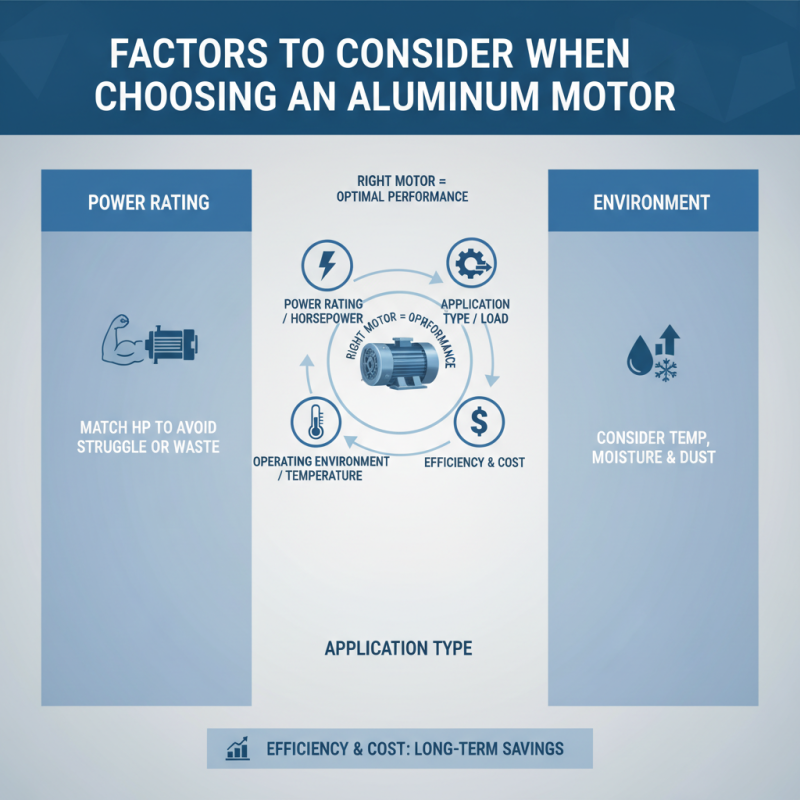
Choosing the right aluminum motor can be challenging. Several factors come into play. One key consideration is the motor's power rating. Identify your application and the required horsepower. A motor that's too small will struggle, while one that's too big can waste energy.
Another important factor is the weight of the motor. Aluminum motors are known for their light weight. However, don’t overlook the balance between weight and strength. A heavy-duty servo may be necessary for demanding applications.
Tips for selecting an aluminum motor: Check the thermal performance. Aluminum dissipates heat well but assess the environment where the motor will be used. Ensure it can handle the heat in your application.
Durability is crucial too. Consider the motor's resistance to corrosion. In humid or dirty environments, protection from elements is vital. You may find that a less expensive motor fails sooner than expected, impacting your work.
Always think twice before making a decision. If possible, consult with experts or gather user reviews. Understanding the long-term implications can save you time and money. Each choice should align with your operational needs.
Evaluating Motor Efficiency and Performance Ratings
When selecting an aluminum motor, efficiency and performance ratings are crucial.
Efficiency impacts the overall energy consumption. A highly efficient motor converts more electrical energy into mechanical energy.
Therefore, consider its efficiency class. Look for ratings that indicate better performance.
High-efficiency motors often save costs in the long run.
Performance ratings also help evaluate individual motors. Understand the torque and speed characteristics.
These factors determine the motor’s suitability for specific applications. It’s vital to match these specs to your project requirements.
Some motors may excel in speed but lack torque. Others may provide high torque but operate at slower speeds.
Make sure to analyze your needs carefully.
Reflect on your application’s demands. An excellent efficiency rating is useless if the motor can't handle load requirements.
Choosing the right motor often involves trade-offs. Test different models to gauge their performance in real-world scenarios.
Some users may overlook this step, leading to unforeseen issues. Pay attention to these details to avoid future complications.
Assessing Cost and Maintenance of Aluminum Motors
When selecting an aluminum motor, cost and maintenance are crucial factors. Aluminum motors offer a lightweight option, which can lead to savings on installation. According to industry reports, these motors can save up to 20% in energy costs over their lifetime. However, while initial costs may seem lower, maintenance expenses can accumulate. Proper care is essential. Regular inspections can prevent more costly repairs down the line.
Maintenance practices vary widely. Some users report challenges in ensuring lubrication. Maintenance frequency may increase in harsh environments. A study indicates that motors in such conditions require maintenance checks every three months. This contrasts with the anticipated annual checks most users plan. Unexpected downtime might arise due to overlooked maintenance schedules.
Choosing an aluminum motor means balancing upfront costs with potential long-term expenses. While they are attractive for their efficiency, one must consider the hidden costs. Understanding your operational environment and usage patterns helps in making an informed decision. It is vital to reflect on how maintenance practices will fit into your capabilities.
How to Choose the Right Aluminum Motor for Your Needs? - Assessing Cost and Maintenance of Aluminum Motors
| Parameter |
Budget Range ($) |
Maintenance Frequency (Months) |
Average Lifespan (Years) |
Weight (lbs) |
| Low Power (0.5 - 1 HP) |
100 - 300 |
12 |
10 |
10 |
| Medium Power (1 - 5 HP) |
300 - 800 |
6 |
8 |
25 |
| High Power (5 - 20 HP) |
800 - 2500 |
3 |
5 |
50 |
| Heavy Duty (20+ HP) |
2500+ |
1 |
3 |
100 |