How to Choose the Right AC Motor for Your Needs?
Choosing the right AC motor can significantly impact your project's success. An AC motor is vital in various applications, from industrial machinery to household appliances. With so many options available, selecting the most suitable motor requires careful consideration.
Understanding your specific requirements is crucial. Factors like power needs, speed range, and efficiency play a key role. Additionally, knowing the environment where the motor will operate is equally important. High temperatures and humidity can affect performance.
Many people overlook these details, leading to inefficient choices. It's essential to evaluate reliability and maintenance needs as well. Reflecting on your decisions can lead to better outcomes. Ultimately, selecting the right AC motor blends expertise and attention to detail.
Understanding the Basics of AC Motors and Their Applications
Choosing the right AC motor starts with understanding its basics. AC motors are widely used in various applications, from household appliances to industrial machinery. Their ability to convert electrical energy into mechanical energy makes them essential in many workflows. Different types of AC motors, like induction motors and synchronous motors, function uniquely. Understanding these fundamentals can help you make informed decisions.
When considering an AC motor, assess your specific needs. Is it for a fan, pump, or conveyor? The load requirements will dictate the motor’s specifications, including torque and speed. In industrial settings, operational efficiency is crucial. However, it’s also important to consider environmental impacts. Motors can affect energy consumption and emissions. This reflection can guide you toward more sustainable choices.
Not all applications require high-performance motors. Sometimes, low-power motors suffice. Misunderstanding these needs can lead to unnecessary expenses. Choosing a motor with excessive capacity can waste energy and increase costs. It’s vital to match the motor correctly to your use case. It’s okay to ask for expert advice when in doubt. The right guidance can lead to better choices.
Identifying Your Power Requirements and Specifications
When choosing an AC motor, identifying your power requirements is crucial.
Consider the application in which the motor will operate. Will it drive a pump, a fan, or perhaps an industrial machine?
The load type will significantly influence your choice.
Calculate the necessary horsepower or kilowatts based on your application. A motor with insufficient power may overheat or fail prematurely.
Next, think about the voltage specifications. Motors operate at different voltages.
Ensure the voltage matches your power source. This mismatched setup could lead to performance issues.
Additionally, assess the environment where the motor will be installed.
Factors like temperature, humidity, and potential exposure to dust or moisture matter.
Each detail adds complexity to your decision-making process.
While gathering this information, remain open to adjustments.
Sometimes, the perfect motor isn't available.
Reflect on your needs and be ready to compromise between specifications and availability.
Finding the right balance can be challenging, but it’s essential for reliable performance.
Remember that thorough research today can prevent costly mistakes in the future.
Evaluating Different Types of AC Motors: Induction vs. Synchronous
When selecting an AC motor, it’s crucial to understand the differences between induction and synchronous motors. Induction motors are popular for their simplicity and cost-effectiveness. They operate on the principle of electromagnetic induction. These motors are commonly used in various applications, such as fans and pumps. They're robust and require minimal maintenance, making them appealing for general use.
On the other hand, synchronous motors maintain a constant speed and are often used in applications requiring precise timing. They rely on the rotor moving in sync with the magnetic field. This characteristic is beneficial in situations where speed variation is unacceptable. However, synchronous motors can be more complex and may require additional components for operation.
Choosing the right motor isn't always clear-cut. It's vital to consider both specific application needs and operational environments. Sometimes, businesses overlook these factors and end up with inefficient systems. Evaluating both types, with their benefits and limitations, helps ensure the best choice for your project. Balancing cost, efficiency, and performance is key.
How to Choose the Right AC Motor for Your Needs?
| Motor Type |
Efficiency |
Torque |
Speed Control |
Applications |
| Induction Motor |
Generally high |
Moderate |
Limited |
Pumps, Fans, Compressors |
| Synchronous Motor |
Higher |
High |
Excellent |
Precision Applications, Robotics |
Assessing Efficiency and Performance Ratings for Your Motor Choice
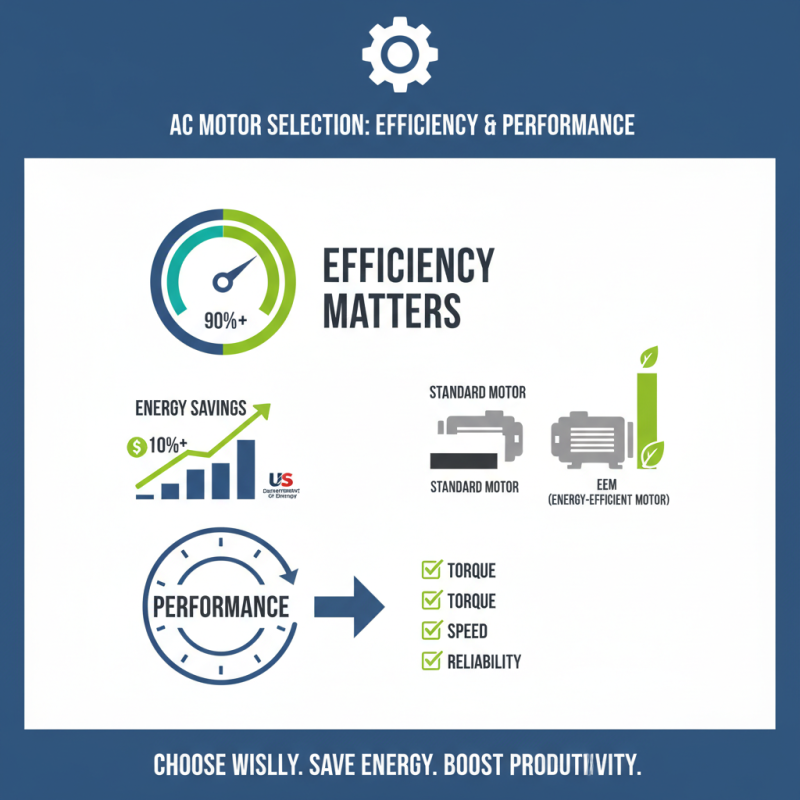
Choosing the right AC motor involves careful consideration of efficiency and performance ratings. Efficiency is critical. According to the U.S. Department of Energy, energy-efficient motors (EEM) can result in energy savings of more than 10%. It’s essential to check the motor’s efficiency rating, often listed as a percentage. A rating above 90% is desirable for most applications.
When evaluating performance ratings, look at the service factor and temperature rating. The service factor indicates the motor’s ability to handle overload conditions. For instance, a service factor of 1.15 means the motor can handle 15% more than its rated load. Additionally, temperature ratings determine operational limits. Motors rated for high temperatures can function reliably in harsh environments.
However, it’s also important to recognize potential drawbacks. Higher efficiency motors can have a higher upfront cost. Therefore, weigh initial investments against long-term savings. Poor match between motor and application leads to decreased performance. Regular audits and adjustments can uncover these issues. Ultimately, thorough evaluations guide effective choices that balance efficiency, cost, and performance.
Considering Environmental and Operational Conditions for Motor Selection
Choosing the right AC motor involves careful consideration of environmental and operational conditions. These factors can greatly influence motor performance and longevity. For instance, temperatures above 40°C can lead to premature motor failure. According to a report by the International Electromechanical Commission, motors operating in high-temperature environments require specialized designs to enhance cooling.
Humidity levels also play a crucial role. Environments with over 60% humidity may increase the risk of insulation breakdown. This risk calls for motors designed with corrosion-resistant features. Reports indicate that approximately 30% of motor failures are attributed to environmental factors. Ensuring proper sealing and materials is essential for operational reliability.
Noise levels in operational settings must be addressed too. Motors can produce noise that impacts working conditions. A study by the National Institute of Standards and Technology found that sound levels above 85 dBA can be damaging over time. Consequently, selecting a motor with lower noise emissions can lead to a healthier work environment. Reflecting on these aspects will guide users in making informed choices, tailoring motor selection to their unique operational contexts.
Environmental and Operational Conditions Impacting AC Motor Selection
This chart illustrates how different environmental and operational conditions can affect the selection of AC motors. The data represents various conditions that should be considered when choosing a suitable motor.